I’ve made a series of paper collages to sell at #Tattoo4Tonga this weekend.
I was inspired after a visit to the Auckland Museum storeroom where I spied some exquisite Fijian breastplates kept in dark little drawers. Being so close to them without a glass cabinet between us, I felt attached and energised by them; I’ve been intrigued with Fijian breastplate design for a long time. Although I was able to photograph them, I was asked not to share the imagery. I loved encountering these beautiful objects and wanted to tell the world! As a social media creature, I found this proposition quite challenging… so, this series came about.
A paper entitled, Uncharted Histories of Ivory Carving Canoe Builders and Canoe Building Ivory Carvers in Western Polynesia, delivered by Steven Hooper at the Pacific Arts Association International Symposium in Vancouver last year gave me a deeper appreciation for the construction of Fijian breastplates. The Chiefs & Governors: Art and Power in Fijiexhibition catalogue published by the Museum of Archeology and Anthropology at the University of Cambridge (UK) has also inspired me. I long-term borrowed it from my parents on a recent trip to Suva, where I also made a quick visit to the Fiji Museum. I love observing the ways in which Fijian objects are kept, discussed, displayed and valued in these very different contexts.
These paper breastplates were created thinking about where these beautiful objects live, in the Auckland War Memorial Museum in New Zealand, thousands of miles from where they came from. I was thinking about value and values, Fijian value and non-Fijian value. And imagining what repatriation would feel like, and in an ideal world, what the Fiji Museum could house and display if they had the resources and leadership of larger international museums.
The works I made use pages of magazines and journals about Auckland, Renaissance art, American muscle cars, contemporary art, oceans, Fijian arts and culture and the Bible.
This series, made specifically for the #Tattoo4Tonga event, measure approximately 250x250mm. They’ll be framed and sold for NZD100 each. All proceeds go towards Cyclone Ian relief in Ha’apai, Tonga.
Driven by Stanley Lolohea from Urban Kupesi Tattoos, TATTOO 4 TONGA is a unique event seeking to raise funds for Tropical Cyclone Ian relief for the people of Ha’apai, Tonga.
Featuring Polynesian tattooists Duss Malaesilia,Kirby Tavita, Geoffrey Siale Thomas as well as Stanley Lolohea, TATTOO 4 TONGA will be a one-day live art event at Fresh Gallery Otara on Saturday 15 February. Audiences will have the opportunity to watch the artists working live from 9am – 2pm, artworks and prints will also be available for sale with ALL proceeds going to support Cyclone Ian relief efforts in Ha’apai.
Tattoo appointments need to be made in advance by contacting the individual artists – see below for details.
Geoffrey Siale Thomas
Stanley Lolohea
Kirby Tavita
Duss Malaesilia
Stanley Lolohea
Kirby Tavita
Geoffrey Siale Thomas
Supported by Auckland-based Tongan art collective, No’o Fakataha, TATTOO 4 TONGA will also be an opportunity to pick up artworks and prints by contemporary Tongan artists that are priced to sell! PIMPI + Friends will also be selling a range of artworks from contemporary Pacific artists; details of which will be released via Facebook leading up to the event.
Severe Tropical Cyclone Ian hit Tonga’s low-lying islands of Ha’apai in early January with wind speeds of up to 279km/hour. The Category 4 cyclone caused widespread destruction with homes and buildings flattened and thousands left homeless.
TATTOO 4 TONGA is an opportunity for Pacific artists in Auckland to contribute their time, energy and skills towards supporting Ha’apai in an act of Pacific solidarity.
The first three exhibitions I’ve visited this year have got me thinking…
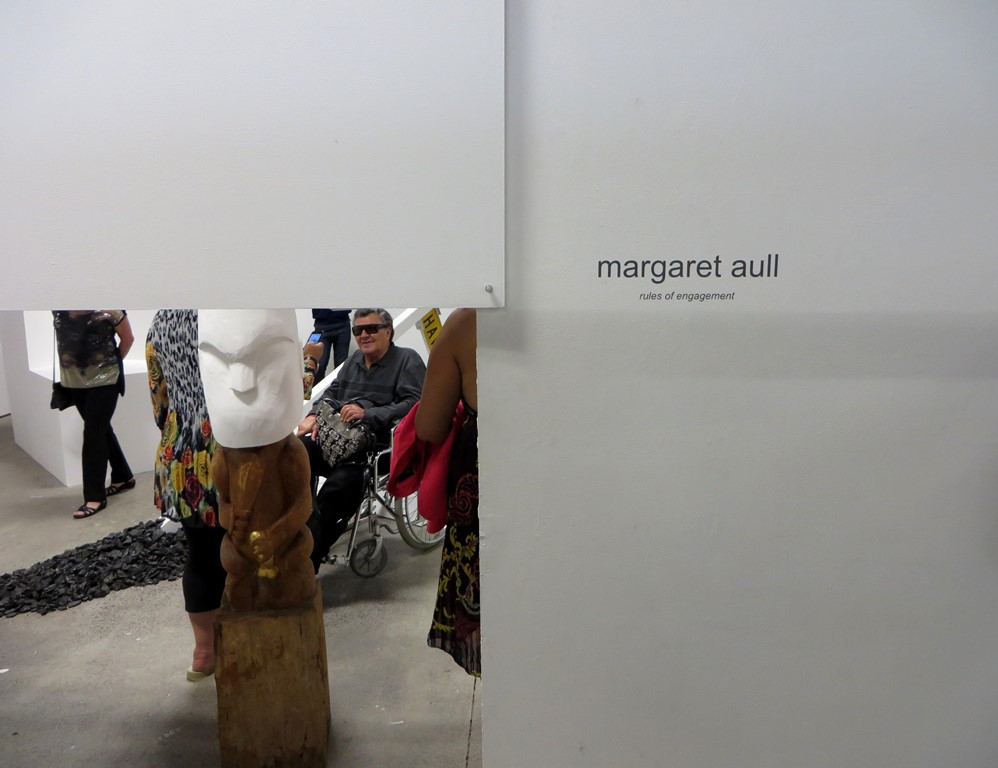
Waikato-based visual artist Margaret Aull (Te Rarawa, Tūwharetoa, Fiji) presented her Master of Fine Arts graduating work this week at Whitecliffe College of Arts & Design in central Auckland (read more here). Cook Islands choreographer Tepaeru-Ariki Lulu French has curated an impressive exhibition at Fresh Gallery Otara, and down the road at Mangere Arts Centre, there’s a long summer exhibition called Agiagiā, which is a Samoan title for an exhibition on the late Pākehā artist, Len Lye.
In the way that so many conversations in the diaspora about Pacific art and artists reflect and respond to colonisation, these exhibitions highlight three notions of cultural exchange. The artists critique and respond to the interface of coloniser and colonised, where cultures blend and bleed into each other. Consciously and unconsciously, the exhibitions present commentary on reciprocity, loss, protocol and power.
The audience experience of this work is an awkward maneuvering around large-scale objects, precarious mirrors and two slightly manic eyeballs. The installation is loaded with Maori mythological symbolism and rooted in Aull’s personal enquiry informed by her dual heritage.
Choreographer and Cook Islands tamure dancer, Tepaeru-Ariki Lulu French has curated an exhibition entitled, The Pacific Muse: The Art, The Dance. It consists of documentation of her ongoing performance piece, The Pacific Muse, from its original presentation during the 2011 Pacific Dance New Zealand Choreographic Lab to Auckland’s 2013 Tempo Dance Festival. From its most recent presentation, a series of stunning staged photographs were produced and are presented as relatively large-scale prints.
Central to the exhibition is the display of the costumes designed and constructed by Valentina Serebrennikova in consultation with French. They are hauntingly beautiful and feel worn, as in imbued with the dance and French’s ongoing research into Pacific female body politics, stereotypes and the legacy and effects of colonisation.
Mangere Arts Centre’s summer exhibition, Len Lye: Agiagiā runs for three long months, an exhibition timeframe better suited to large public institutions and museums rather than community galleries. Len Lye was a New Zealand artist known for his innovative experimental film practice; co-curator, James Pinker states in the exhibition’s media release that “Lye was one of the first Pākehā artists to appreciate indigenous cultures around the world.” *side-eye*
The galleries are painted black. The exhibition consists of framed drawings, kinetic sculptures and videos. Whilst there is a lengthy introductory wall text, the exhibition lacks any interpretive text and moving throughout the space, my guest and I felt detached and emotionless at the lack of information and assumed importance of the works. Whilst a museum has a duty to inform and educate its customers, galleries seem to have less accountability for an exhibition’s transmission, a problematic dynamic in the case of a ratepayer-funded community gallery.
Len Lye’s notoriety as an artist is not common knowledge even amongst arts educated audiences; the value of his work is not mutually translatable. He used Pacific imagery in some of his work, and the exhibition has a Samoan title, but the relevance to the Pacific, and potentially Pacific Island audiences, is superficial. Mangere Arts Centre’s audiences are diverse but I find it frustrating that a publicly funded community gallery clearly prioritises for industry and academic audiences before considering the experience and expectations of its local community.
Whilst attendance numbers and mainstream media reviews will translate to bureaucratic boxes ticked, measuring engagement rarely reflects the reality of disengagement. Mangere Arts Centre doesn’t have a suggestions box and there are rarely opportunities to provide feedback on their programming. I’m not alone in wishing that such a well-equipped facility and resource could better serve the community and context it sits within; disappointment and frustration is evident at a community level, but rather than complain, people just don’t go back.
So, 2014 – here we go, here’s to another year of art projects and real talk!
Waikato-based visual artist Margaret Aull (Te Rarawa, Tūwharetoa, Fiji) presented her Master of Fine Arts graduating work at Whitecliffe College of Arts & Design in central Auckland this week. I wrote a short comment for her exhibition catalogue…
Margaret Aull’s work over the past two years has traced the formation of a pan-cultural understanding of the notion of tapu, drawing from both Fijian and Māori frameworks. From the pictorial to the physical, her paintings have become sculpturally realised in installations that need to be physically negotiated. Throughout this process, the notion of tapu has been researched, discussed and experienced; the idea of sacredness considered in relation to objects and history, gender and power, time and space.
The interface of non-Fijian and non-Māori critical audiences has influenced and evolved her visual vocabulary; her work carries the sense of a deeply significant personal enquiry that is both protected and powerful. There are things that cannot be deconstructed for the purpose of intercultural understanding; there are senses of balance and belonging which cannot be translated into English. It is because of this cultural interface that I see Aull’s installation works as constructed environments for audiences to experience the role of observer.
Engaging with her work is to enact the manner in which protocol and presence is adjusted naturally to accommodate for unseen forces of socio-cultural mores. Such forces are embedded in epistemologies and ontologies, in land, sea and soil, in hearts, minds and memories.
Using imagery of her own body, Margaret confronts audiences with a further dimension of two-way self-reflection. Larger than life, her detached skin, eyes and teeth are loaded in political and emotional codes of race and beauty, sexuality and power.
At the culmination of her postgraduate enquiry, this work maps Aull’s personal and intercultural journey of understanding the notion of sacredness, of safety and of self.
I’ve loved watching the developments of Margaret’s work and I’m excited to see what’s to come!
I’ve been aware over the past few months of Auckland’s need for better waste management attitudes. Auckland Council is introducing new fees for rubbish removal and residents, particularly in South Auckland, have to start recycling, composting and re-using to accommodate for the changes or face significant financial pressure. I’ve been thinking about creative ways to engage communities, particularly in Ōtāhuhu, with projects and activities that involve re-using, re-purposing and re-thinking what we throw out.
Leading up to Christmas and with some down-time between projects, I started making a series of wreaths from out-of-date Fresh Gallery Otara brochures. Cutting them into strips and weaving them together has had me thinking about when this brochure was first developed; Fresh Gallery Otara had been in operation for two years but this was the first real marketing collateral produced for the Gallery. It was important because in 2008, I went on two trips; first to the 10th Festival of Pacific Arts in Pago Pago, American Samoa, and second, to Bandung, Indonesia on an amazing fact finding mission with the British Council. This brochure was an essential part of Fresh’s international exposure; it showcased the Gallery’s community of artists and its curatorial culture.
I was exceedingly proud to distribute it everywhere I went; graphic designer, Edgar Melitao did an exceptional job and has always made my projects and work feel international, very cool and quietly sophisticated. As I weave different sized pieces together, I’ve reflected on Edgar’s amazing attention to detail. In the feel of the paper, I think about his consideration of paper stock and quality. I love that his graphic triangle theme is unintentionally continued in this brochure’s new life.
These wreaths will be for sale exclusively at Fresh Art Market, Saturday 14 December, at Fresh Gallery Otara. They cost $20 each and measure approximately 46cm across!
A new pilot event at Fresh Gallery Otara aims to showcase the potential of creative entrepreneurship in South Auckland.
Fresh Art Market is a lively pop-up market day presenting a diverse range of creative products and services including fashion design, nail artistry, event and project management, homeware and photography alongside the more traditional paintings and prints.
Event organiser, Ema Tavola says, “Fresh Art Market is a microcosm of South Auckland’s creative ecology – our artists are not just exhibiting in galleries but earning a living in a range of ways from photographing and designing events, painting murals, facilitating workshops and creating works of art in hair and nails.”
The event is in part influenced from Tavola’s involvement with a colleague from the Indonesian city of Bandung, well regarded for its innovative creative economy. Dian Gesuri has been in New Zealand completing a Master of Arts Management degree at AUT University; the two have spent six weeks sharing ideas about creative entrepreneurship and sector development in an informal residency at Tavola’s home in South Auckland.
Gesuri will deliver a presentation at Fresh Art Market from 9 – 10am on what South Auckland can gain from harnessing creativity and community, collaboration and commerce. Her talk will introduce some inspiring models of creative entrepreneurship that have contributed to social change in Bandung.
Gesuri says, “The driving force of Bandung’s creative economy is people and community, something South Auckland is rich in; the potential for creative economic growth here is significant.”
Stallholders will be offering specials and discounts across all products and services from manicure and pedicure gift vouchers to couture garments, t-shirts, portrait photography, artworks and hand-made accessories.
Tavola says, “This is a perfect time to support local creative entrepreneurs – their products and services are priced to sell and locally designed and produced gifts and treats are an investment in our local creative economy. This will be a truly inspiring day!”
Artists / Creative Entreprenuers involved: Leah Espie Photography, FAF SWAG, Tui and Sulieti Gillies, Tepora Malo, Nesian Nails, The Roots Creative Entreprenuers, Czarina Wilson Design.
Event details When: Saturday 14 December, 9am – 2pm
Where: Fresh Gallery Otara, 5/46 Fairmall, Otara Town Centre, South Auckland
Instigated by Samoan writer, teacher and community activist, Leilani Salesa, The Rise of the Morning Star was a performance undertaken on Auckland’s Queen Street on Sunday 1 December 2013 as part of a network of global events to create awareness and activate support for the struggle towards independence in West Papua.
It was an honour and privilege to be part of this collective of Maori and Pacific women standing in solidarity, activating our own awareness, moving with love and intention, silence, respect, sadness and hope. Leilani designed this performance because, “our freedom as indigenous Maori and Pacific women in Aotearoa/New Zealand is inextricably bound up with that of our indigenous West Papua brothers and sisters. We call on all New Zealanders to take notice, that at this very moment in the Pacific, there is a genocide taking place”. Read more here.
The performance included an ordered procession down Queen Street stopping at three major intersections. When the pedestrian light turned green, the performers assembled in a circle around Salesa in the middle of the intersection. Facing outward, the women raised their right fists to the sky as a gesture of solidarity. Throughout the performance, the Morning Star flag representing the West Papua independence movement, was symbolically raised 15 times, a reference to the 15 year jail sentence handed to Papuan independence activist, Filep Karma in 2004 for raising the flag at ceremony in Jayapura, Indonesia.
The performance symbolically began and ended at Selwyn Muru’s public sculpture, Waharoa, a stylised Maori gateway in Auckland’s Aotea Square. The performance inspired emotion amongst all its participants; in its silence, its visibility and in the stark juxtaposition of consumerism and commerce with the quiet reflection and gratitude for the freedom of expression, speech and for independence.
Whilst the issues are large, and there is much to know and understand, small gestures of awareness and opportunities to reflect on our positions as indigenous Pacific women are inspiring and commendable. Well done, Leilani Salesa and sincere thanks to the women who took time out to support, to be aware and be visible.
Artistic Intervention to Support Human Rights in West Papua
10:30am, Sunday 1 December
Wellesley & Queen Street Intersection, Central Auckland
On West Papuan Independence day—1 December—a group of indigenous Maori and Pacific women performers will stage an artistic intervention in Queen Street, central Auckland, to raise awareness of human rights abuses in West Papua.
Despite risking long jail sentences West Papuans continue to mobilise and raise the banned Morning Star flag on 1 December.
The performance will begin at 10:30am and travel from Selwyn Muru’s Waharoa at the entrance of Aotea Square, down Queen Street.
With support from West Papua Action Auckland (WPAA) the Morning Star flag—the flag of West Papua—will be raised in an act of solidarity.
Leilani Salesa, a member of WPAA and coordinator of the performance, said: “We are staging this artistic intervention because our freedom as indigenous Maori and Pacific women in Aotearoa/New Zealand is inextricably bound up with that of our indigenous West Papua brothers and sisters. We call on all New Zealanders to take notice, that at this very moment in the Pacific, there is a genocide taking place”.
The performers will join a day of mass action worldwide, with demonstrations planned in Melbourne, Brisbane, Port Moresby, London, The Hague, and many other places.
1 December is the anniversary of the 1961 West Papuan Declaration of Independence from Dutch colonial rule. In 1963 Indonesia took military and territorial control of the administration of West Papua against the will of the indigenous population. Human rights groups estimate that some 100,000 West Papuan people have died in the ongoing conflict.
West Papuan people are constantly terrorised by the Indonesian military, paramilitary police and intelligence agencies, while movements of journalists and humanitarian workers are excluded or tightly restricted. Despite risking long jail sentences West Papuans continue to mobilise and raise the banned Morning Star flag on 1 December.
Media enquiries:
For information about the 1 December event or for photos of the performance please contact Leilani Salesa on 021 743 647 or postcolonialtheory@gmail.com
For general information about WPAA please contact Marni Gilbert on marnilisa@gmail.com
Notes:
Globally there is a growing movement of solidarity for West Papua and recognition of the need for urgent action.
In September 2013 Prime Minister of Vanuatu Moana Kalosil Carcasses called on the United Nations to urgently appoint a special representative to investigate allegations of current and historic human rights abuses in West Papua as well as West Papua’s political status. Kalosil said West Papuans had been consistently denied any sort of recognition by the world body.
A 2013 report in the Griffith Journal of Law and Human Dignity by Dr Jim Elmslie and Dr Camellia Webb-Gannon shows the Indonesian Government is responsible for genocide in West Papua. The authors found that accumulated evidence over the past 50 years is now of such strength that it meets the criteria for genocide set out in the 1948 Genocide Convention.
An online campaign Papuans Behind Bars launched in 2013 documents the growing numbers of political prisoners in West Papua, many of whom have suffered arbitrary arrest, violence, abuse, torture, unfair trials, intimidation and neglect. The current Police Chief Tito Karnavian trained in New Zealand in 1998 at our Defence College. He is believed to be responsible for the current repressive policing practice. In 2013, the New Zealand Government announced plans to restart its Papuan Community Policing programme in West Papua.
Canadian human rights activist Jeremy Bally visited New Zealand in October as part of his 12,000km international cycling and performance tour Pedalling for Papua. The Free West Papua Campaign, co-launched by West Papuan Independence leader Benny Wenda (who visited NZ in 2012) now has permanent offices in Oxford, The Hague and Port Moresby. Likewise the International Lawyers for West Papua and International Parliamentarians for West Papua are growing in numbers. Also driving this global movement are numerous largely volunteer run organisations and campaigns coordinated by solidarity activists and West Papuans living in exile (see Rize of the Morning Star).
West Papua Action Auckland (WPAA) is an informal and independent group of volunteers that share a commitment to support and promote human rights in West Papua and maintain a watching brief on NZ Government policy. As a solidarity organisation, WPAA believes that specific campaigns should be influenced by the kinds of campaigns and priorities taken by West Papuans.
FRESH ART MARKET is a lively pop-up market day presenting a diverse range of creative practice and free public programme events at South Auckland’s notorious Fresh Gallery Otara!
The event draws together a diverse range of creative practitioners from fine artists to activists, object makers and writers to fashion designers. With everything priced to sell, FRESH ART MARKET is an ideal one stop shop for conscious, hand-made, locally designed gifts and treats!
Throughout the day, a series of public programme events will take place alongside the Market:
From 9-10am, join visiting arts manager, Dian Ika Gesuri for an inspiring discussion on what Auckland can learn from harnessing creativity, community, collaboration, innovation and commerce, introducing some amazing models of creative entrepreneurship that contribute to social change in the city of Bandung, Indonesia.
At 11am, check out a series of short films including Luisa Tora’s “Home Videos” (2013) and join the film makers for a Q&A.
From 1-2pm, exhibiting artists Sam Afu and ‘Ahota’e’iloa Toetu’u are delivering a free painting workshop inspired by their current exhibition, Ua gau le sila, tuku ki Manono on at Fresh Gallery Otara until 21 December.
Keep an eye on the Facebook event page for updates and specials or send us an enquiry here:
Since September I’ve been coordinating OTARAfest, a new annual event programme produced by Manukau Institute of Technology (MIT) Faculty of Creative Arts; it ran from 18 October – 2 November and the inaugural programme included 11 stand-alone events delivered in and around the Otara Town Centre.
With a focus on revitalising the Otara Town Centre and creating opportunities for artists and the wider community to meet, share and reflect on contemporary art, talent and creative energy emanating from the local environment, OTARAfest was a refreshing and hugely rewarding project to be part of.
The programme was officially launched at the opening of Fresh Out of School, an exhibition at Fresh Gallery Otara featuring six new graduates from the outgoing Bachelor of Visual Arts degree programme offered at MIT Faculty of Creative Arts. The opening was a celebration of achievement for the students involved; we wanted to emphasise their commitment and hard work, and their new beginnings as qualified visual artists. The Gallery was filled with family and friends, music was provided by DJ Al’Goodie, a well-respected local DJ and radio personality and slow-cooked pork sliders, raw fish and smoked salmon bilinis were served courtesy of Lissy’s Kitchen.
Desire2Inspire, a local arts collective performed at the OTARAfest launch. With all its members currently engaged in youth work and related training, the two skits they presented were informed by lived realities for young people in South Auckland; managing peer pressure, the influences of drugs, alcohol and suicide, and the healing potential of faith and fellowship. I was so moved by their performances, their involvement and interest in the OTARAfest programme; it brought the community back inside the walls / windows of Fresh Gallery Otara and served as a reminder of the consciousness a local community art gallery should reflect.
OTARAcube was a new exhibitions concept that unfortunately launched two weeks behind schedule, meaning a performance work due to take place in the first weekend of the programme was sadly cancelled. However, its better-late-than-never arrival enabled the launch of its inaugural exhibition featuring Tongan artist sisters, Vea and Emily Mafile’o. The opening of their multimedia installation coincided with a special gathering of the Tongan art collective, No’o Fakataha at Fresh Gallery Otara on Friday 1 November.
An initiative of MIT Faculty of Creative Arts with support from the Otara-Papatoetoe Local Board, the OTARAcube started life as a 20 foot shipping container; its design and customisation was undertaken by Nigel Burton (DVANZ). Now a permanent fixture in the Otara Town Centre, OTARAcube is located in the area between the Bus Depot and the taxi stand; site specific exhibitions and experimental art projects are planned to turnover on a roughly monthly basis.
OTARAfest provided a platform for a series of gathering and networking events, one of which heralded the beginning of the South Auckland Young Artists Network (SAYAN), a new movement based on the successful Youth Arts Committee at central Auckland community art centre, Artstation. SAYAN will meet fortnightly at Fresh Gallery Otara, contact Kirstin Whalen to go on the mailing list.
South Auckland Theatre Collective presented their first production, My Life, My Story, My South Auckland and got this sweet review, the wonderful P.O.T Productions delivered a beautiful re-worked and site-specific version of Pukepuke ‘O Tonga and OTARAwindow, a series of three outdoor window boxes on the exterior wall of Otara Family & Christian Health Centre, featured the work of Luisa Tora for the duration of OTARAfest.
I enjoyed so many facets of project managing this event programme, but one event in particular was an absolute career highlight. I had the privilege of working again with Tanu Gago, co-founder of FAF SWAG, a collective that advocates, promotes and endorses youth voices from South Auckland’s Pacific LGBTQI communities. Inspired by the American documentary film, Paris Is Burning, the first FAFSWAG Ball aimed to create a competitive platform centralising talent, performance prowess and safety in an accessibly priced, event experience unique to South Auckland.
The FAFSWAG Ball was affirming, electric, covered in glitter and tear-inducingly empowering!
As of 24 hours ago, I’ve also officially completed all the required outcomes for my Master of Arts Management degree at AUT University and I’m so relieved! I’m deeply thankful to my partner, my friends and family for helping me study and endure the financial hardship of committing to full-time postgraduate study, and especially to my mother, who has listened, advised and encouraged me to not give up, thanks Mum!
This weekend I’m showing two works in the annual King’s College Fine Art Sale and on Sunday I’ll be delivering a talk on Pacific art making and appreciation in South Auckland from 12.45pm, click here for more details.
Check out this track by Otara artist, Beelah – it is the soundtrack of Vea and Emily Mafile’o’s OTARAcube exhibition and was shot and recorded right here in Otara – love it!







 PIMPI KNOWS