“E Moemoea” (2012) by Margaret Aull, acrylic, ink, collage on paper.

Concealed Ancestors is the upcoming solo exhibition by Waikato-based visual artist, Margaret Aull, co-curated by Nigel Borell and Ema Tavola for Papakura Art Gallery, South Auckland.

In this new body of work, Aull investigates the concept of tapu / tabu within both Maori and Fijian cultural frameworks. Inspired by research at the Fiji Museum, she explores visual representations of ancestors and deities, spiritual lore, mana and life force.

Utlising ochre used in the making of masi (traditional Fijian bark cloth), Aull incorporates the whenua / vanua within her work. Juxtaposed with imagery from Museum collections, she reclaims and re-activates meaning, creating visual mediations of her blurred genetic code.

Margaret Aull (Te Rarawa, Tuwharetoa, Fiji) has exhibited extensively in New Zealand since 2005 and is currently completing a Master of Fine Arts at Whitecliffe College of Arts & Design.

Check out Concealed Ancestors at Papakura Art Gallery from 12 January – 23 February 2013.

Concealed Ancestors is produced with support from the Pacific Arts Committee, Creative New Zealand and Toi o Manukau.

Click here to read more about Concealed Ancestors

The AMP Peoples Choice Scholarship is won every year by public vote. Over the years I’ve voted for authors and artists, poets and designers – the programme supports extraordinary kiwis doing great things and skilled Pacific creatives have often applied. So this year I’m giving it a go.

Every vote counts and voting is open to anyone with a Facebook account!

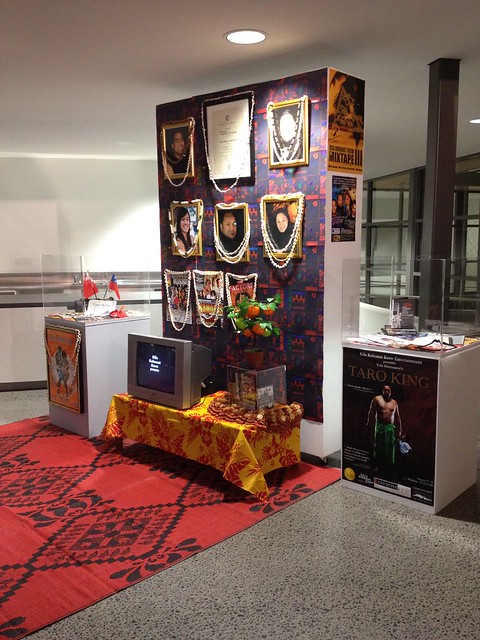
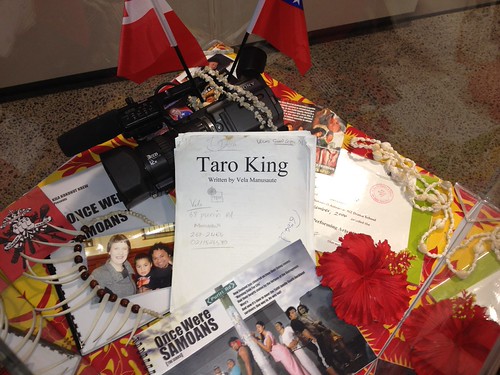
I’ve been invited to curate a small-scale exhibition about the South Auckland entertainment company, Kila Kokonut Krew (KKK) at Mangere Arts Centre – Ngā Tohu o Uenuku. The exhibition acknowledges the 10th anniversary of KKK and coincides with the company’s 2012 presentation of Taro King – the first play they produced in 2002.

This is the second exhibition I’ve curated about Kila Kokonut Krew; the first one, From The Pacific We Rise, took place at Fresh Gallery Otara in 2008. At the time, the company was multifaceted with the music (Nafanua Records), T-shirts (Phat Islanders), the theatre and KTV – Kila Kokonut Krew Television. Fresh Gallery Otara had no operational budget at this time; the exhibition came together with limited resources but successfully depicted the breadth, depth and energy of KKK.

Both KKK and I have come a long way since that first show. Kila Kokonut Krew is now recognised as New Zealand’s leading professional Pacific theatre company and receives regular support from Creative New Zealand. I went on to produce another 50 or so exhibitions in and around South Auckland. Mangere Arts Centre was opened in 2010 and its beautiful new theatre has become a home for KKK and an ideal space to celebrate this landmark anniversary.

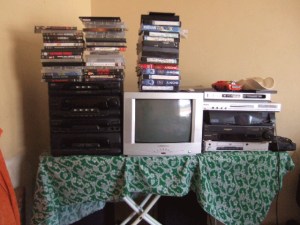
The exhibition I’ve developed this year is based on a Pacific Island lounge. I’ve been inspired by an early photographic series by Māori / Niuean / Samoan visual artist, Janet Lilo called Aunty Tina’s House. I’ve also drawn on the experience of being an associate curator for Home AKL at Auckland Art Gallery, an exhibition that feels so far from my own sense of home.
I wanted to create a domestic environment in the Mangere Arts Centre foyer that would invite audiences to sit and relax… to feel at home. Seeing Kila Kokonut Krew’s humour and South Aucklandisms on mainstream stages in central Auckland has always reinforced my connections to the Southside. I wanted to create an exhibition that felt like KKK’s home – a space of comfort and reflection, Pacific cultural pride and markers of growth and development, people and achievement.

The Kila Kokonut Krew 10th Anniversary season including Taro King and the Celebrating 10 years of Kila Kokonut Krew exhibition take place at Mangere Arts Centre – Ngā Tohu o Uenuku from 15-24 August 2012.

The new exhibition Home AKL at Auckland Art Gallery Toi o Tāmaki features 28 Pacific artists, many of which live in South Auckland. In a series of posts about Home AKL‘s South Auckland interface, I asked Associate Curator, Kolokesa Māhina-Tuai about her home suburb of Ōtāhuhu.

How are you involved with Home AKL?

I am involved in Home AKL as an associate curator. My contribution has mainly focused on working with master weavers and crochet artists from Kiribati, Niue and Tuvalu, fine women artists and a multimedia artist from Tonga and a masi (Fijian tapa) printer from Fiji.

Where is home?

I am an Ōtāhuhu resident and have lived here with my husband Kenneth and two daughters – Meleseini (4 years old) and Akesiumeimoana (8 months) – for just over four years. The house that we live in is my husband’s family home where he and his family have lived in since 1981 – so over 31 years – although they have been Ōtāhuhu residents for 35 years. While I consider myself a ‘newby’ I’ve had the advantage of my husband and my in-laws intimate knowledge of Ōtāhuhu guide me especially the best places to eat at. I’ve tried various ethnic food places and my favourite Vietnamese would be Try it Out Vietnamese Restaurant on Atkinson Ave, for Thai I would opt for the Thai food places at Food City Ethnic Food Court on Mason Ave (if you want great food for an affordable price), or Secret Thai Garden Restaurant on Station Rd with its amazing décor which is more pricier but good food nonetheless, and for Malaysian I would recommend Penang Café also on Station Rd. I have also recently discovered AW (Affirming Works) Community Café on the corner of Great South Rd and Princes St, directly across from the Ōtāhuhu Police Station – they do great coffee (grown and imported from Tonga) served in big mugs! My daughter Meleseini and I also love our keke ‘isite (Tongan round pancakes) and a close alternative would be the Samoan panikeke (round pancakes) sold at Pinati’s Keke Pua’a shop on Queen St.

When I first moved to Ōtāhuhu in 2008 my favourite shops that I frequented on a weekly basis were three op shops – one on Great South Rd at the post shop end, the second one on Mason Ave across from the Holy Trinity Anglican Church and the third on Salesyard Rd. My daughter Meleseini and I would attend the wriggle and rhyme programme at the Ōtāhuhu library on High St every Thursday and on our way home we would come through all three op shops. The two op-shops in the Ōtāhuhu town centre have since closed down and there is only the one on Salesyard Rd that remains. Since September last year Meleseini has attended Wee Wisdom Montessori Preschool here in Ōtāhuhu on Walmsley St and loves it. Akesiumeimoana and I continue to attend the weekly wriggle and rhyme programme, which runs on a Tuesday now at the local library and still pop into the op shop on Salesyard Rd now and then.

I came to New Zealand when I was about three years old and have always lived in Central Auckland – first in Grafton, then Parnell and then Mt Eden where my family still lives today. Since living in Ōtāhuhu there are noticeable differences. I love the cultural diversity that can be found here in Ōtāhuhu. I love walking through the Ōtāhuhu town centre and seeing so many brown faces and listening to conversations in various Pacific languages. I also love the proud and long history that Ōtāhuhu holds of which I am still learning about. If you knew nothing about Ōtāhuhu, the façade of old buildings along the town centre and old villas around Ōtāhuhu are tangible evidence of a place with a long history. Some of the interesting historical facts about Ōtāhuhu that my husband has told me about include being:

  • The home of New Zealand’s first supermarket which was located on Great South Rd heading south just before the Dominion Breweries and currently has a petrol station and couple of shops.
  • The current location of Ōtāhuhu College where David Lange (former NZ Prime Minister), David Tua, Sir Barry Curtis (ex-Mayor of Manukau) and Home AKL artists Leilani Kake and Angela Tiatia and Home AKL patron Albert Refiti attended.
  • The location of the old railway workshops where it was one of two major workshops in the north island where trains were fixed. The old railway houses still standing around Ōtāhuhu is a reminder of this time.
  • The home of the Ōtāhuhu Leopards where five New Zealand Kiwis captains have come from including famous coach Graham Lowe.
  • That Xena and Hercules were filmed at the warehouses behind the Harlech House, which currently houses NZ police. It is the tallest building in Ōtāhuhu on Great South Road near KFC.

Why would you like to see South Aucklanders going to see Home AKL?

The Auckland Art Gallery is not an institution that is regularly frequented by islanders let alone South Aucklanders. However, Home AKL is an exhibition worth seeing because the majority of the artists featured are from South Auckland. Those that also frequented Fresh Gallery Otara would see many of the artists that showed there in Home AKL. This is a testament of South Auckland being the heart of Pacific Art. As South Aucklanders, this is something to be proud of and hopefully a good enough reason to make your first visit to Auckland Art Gallery or better yet become a regular visitor for the duration of Home AKL.

The last exhibition I curated at Fresh Gallery Otara was called WWJD (What Would Jim Do?). It was a gesture of appreciation for the leadership and trailblazing of the late Jim Vivieaere (1947-2011).

Tanu Gago and I collaborated to produce this video about the exhibition and its artists. It features excerpts of Jim speaking at the 2010 Curating Pacific Art Forum in South Auckland, part of the Manukau Pacific Arts Summit. For me, the Forum was the most meaningful gathering of Pacific thinkers foregrounding Pacific ways of looking and relating with regards to curatorship. Jim’s contribution is/was/will always be invaluable.


My Pacific & My Auckland

Story by Ema Tavola

Fundamentally, I am opposed to the idea of Auckland being called a Pacific city. I don’t take the word Pacific lightly. It describes my heritage, community and socio-political context, and Auckland reflects little to nothing of who I am.

I am from Suva, Fiji – an actual Pacific city. Fiji’s capital is teeming with Nesian flavour. Void of resorts, Suva is a melting pot of the Pacific with its embassies, regional organisations, tertiary institutions and thriving commercial centres. Pacific people, Fiji people, are the newsmakers, the politicians, the event planners, the strategists, the teachers… the leaders. While plagued with political instability for much of my lifetime, Suva is where the Pacific is truly present.

I live in South Auckland and have studied and worked in Otara for the past decade. The community I call home here in New Zealand is predominantly Polynesian. In Otara, New Zealand’s demographics are turned upside down and the Pacific community defines, creates and is the mainstream. I feel close to the Pacific because I am surrounded by Pacificness – language, laughter, children, brown skin, food and movement. I still get a culture shock when I leave South Auckland and I feel a deep sense of relief when I return.

Because I am embedded in a sense of the Pacific proper and also in the Pacific relocated in Otara, Pacificness for me is where we/I am visible. In Auckland, the Pacific community makes up 14 per cent of the population, less than that of the Asian community and less than a third of that of Pākehā. We are a minority on the margins. As such, Pacific people and issues rarely feature in mainstream media and are rarely seen in advertising. Our representation in the leadership and governance of Auckland is grossly under par. For a Pacific city, Pacific people seem fairly invisible.

Auckland is a settler city now home to a multitude of ethnic groups. Central Auckland hosts the annual Pasifika festival attracting broad audiences to a two-day celebration of Pacific music, food and culture.

But Pasifika is no more important than the other major cultural events like the Lantern Festival celebrating Chinese New Year, and Diwali Festival of Lights. These large-scale culture expos paint a picture of Auckland’s diverse economic potential, giving minority communities the civic limelight for one to two days in the year.

But Auckland is home to the majority of New Zealand’s Pacific population. Now generationally entrenched, over 50 per cent of the population is New Zealand born. The Pacific diaspora has become increasingly integrated into the social fabric of New Zealand and as the community grows, identities evolve. For many Pacific people, our perceived identity is not related so much to where we are, but to where we have become visible when previously we were invisible. The number of Pacific Islanders playing elite schoolboy rugby has grown from almost none to domination of many of the teams.

This creates a problematic measure of Pacific identity. It is arguably a model of oppressed thinking from a community still over-represented in statistics around poor educational achievement, poverty and political dislocation. It feels like a strange colonial Stockholm syndrome that stops us expecting and demanding more of a country that has been built in part on the backs of Pacific labour.

If Auckland were truly a Pacific city I would expect a deeper consciousness about Pacific people and ideas, the wider region and our relationship with not only Polynesia, but Melanesia and Micronesia.

Whilst we have visibility in sports and in small windows of programming on mainstream television, we need to have visibility in decision-making at local and central government levels. We need more leadership in our community, in order to have presence and contribute fully to the Auckland dynamic. Potentially, strong and informed Pacific leaders could confront the large-scale political disenfranchisement we saw so clearly in our last national elections.

In a truly Pacific Auckland, engagement with Pacific communities would be meaningful, intergenerational and mutually beneficial. Mainstream institutions would not only foster relationships with Pacific communities, but actively deliver programming which appeals and educates wider audiences on Pacific lives and experiences.

I’d like to think that in an Auckland conscious of its Pacific community, we would stop building environments that enslave and harm our most disadvantaged sectors.

There are too many urban health hazards: there shouldn’t be liquor stores and takeaways on every corner and substandard imported food sold at every dairy in Mangere, Otara and Ōtāhuhu.

SkyCity and everyone else who introduces pokie machines to the community should be considered stakeholders in problem gambling, and held responsible for the damage they cause.

Tighter regulations around targeted and exploitative money lending would stabilise a community already faced with disproportionate financial challenges.

Sports commentators, news readers and leaders would be educated in how to pronounce Pacific names, and they would understand that mispronunciation is offensive and unnecessary.

Right now in New Zealand, emigration has never looked so appealing. Like many of my friends and networks, I look for jobs regularly in Australia.

If I left, the truth is I would miss South Auckland terribly. I would miss this little piece of the Pacific with its abundance of churches, swarms of brown children, multi-coloured everything. Here, Pacific people have made their mark – survived adversity and built strong, proud communities. Much of South Auckland exists in a parallel universe to the wider Auckland region; it was a self-sufficient little world before the Super City.

If an amalgamated Auckland means South Auckland’s Pacificness is now part of a bigger blander civic picture, then perhaps Auckland is a Pacific City. But there is no doubt in my mind that South Auckland is its beating heart.

This article was written for Metro magazine (August 2012)
4 Comments

HOME AKL FREE BUS

There is a free bus service running from Mangere Arts Centre – Ngā Tohu o Uenuku in South Auckland to Auckland Art Gallery Toi o Tāmaki in Central Auckland each Saturday in August!

See life through the eyes of Auckland’s Pacific artists in the new exhibition, Home AKL – the first major group exhibition of contemporary Pacific art developed by Auckland Art Gallery!

The bus departs at 12pm from Mangere Arts Centre – Ngā Tohu o Uenuku, located in the Mangere Town Centre at the corner of Bader Drive and Orly Avenue. Park in the rear car park at the corner of Orly Avenue and Waddon Place.

The bus goes directly to Auckland Art Gallery Toi o Tāmaki arriving around 1pm, in time to participate in weekly public programme events.

The bus returns at 3pm – the pick-up is from Wellesley Street, by Albert Park.

WHAT DOES IT COST

The bus is free, and entry to Auckland Art Gallery Toi o Tāmaki – however, Home AKL is a special exhibition that has an entry fee. Ticket pricing is as follows:

Single Admission $5
Concessions (Student, Beneficiary, Senior Citizens, Groups over 10) $3
Children 14 and under FREE 

A season pass can also be purchased for $20 – this enables visitors to visit as many times as they like!

Read more about this initiative here

Model is wearing XL

The new YOU LOVE MY FRESH t-shirts are in and ready to sent out into the world.
More photos coming soon.

This is the first of a series of art t-shirts produced by PIMPI on behalf of exciting South Auckland and Pacific artists.
Watch this space!

Tshirts are NZ$40 + $5 postage+packaging (within New Zealand)

Email Ema for more information

South Auckland multimedia artist Siliga David Setoga is currently showing in Home AKL at Auckland Art Gallery (until 22 October). We share a love and respect for Otara – he has been selling t-shirts at the Otara Market under his label, Popohardwear for the past decade. Setoga held his first solo exhibition at Fresh Gallery Otara during my time as the manager and curator.  He made this shirt for me and I love it.

Check out the current issue of The Listener (July 28 – August 3, Issue 3768) – Anthony Byrt has written as kickass review of Home AKL at Auckland Art Gallery.