Posts tagged ‘Otara’

Leilani Kake and I had a stall at the GROUNDED Festival of Sustainable Arts pop-up market last weekend, hosted by Manukau Institute of Technology’s Faculty of Creative Arts in Otara, South Auckland.

The #2girls1conference fundraising campaign t-shirt is designed by senior student, Tepora Malo, currently studying to complete a Bachelor of Creative Arts. Tepora undertook an internship with Leilani and I on the #2girls1conference campaign, overseeing the process of crowdfunding, social media marketing and leading the design and hand-printing of the limited edition t-shirt.

Tepora’s design employed a complex printing process that presented a fairly massive learning curve for all involved! The outcome is gorgeous and represents multiple hours of trial and error, laughs, sweat and tears!

We produced a limited range of 70 t-shirts and 20 canvas tote bags – both are selling fast; sales enquiries can be directed to Ema using the Contact page here.

The PIMPI fans are seasonally misguided, but on sale for NZ$60.

Images courtesy of MIT Faculty of Creative Arts.

Leilani Kake and my fundraising efforts to get to the Pacific Arts Association International Symposium in August are gaining real momentum!

A 25-day campaign on the New Zealand crowdfunding website, PledgeMe was an enormous success – we were overwhelmed with the support from our communities and networks on and offline. This initial fundraising effort attracted over $4000 of support which covers the bulk of our return airfares to Canada! A HUGE Thank You to everyone who pledged, shared, liked and retweeted to support our cause.

Part of our fundraising effort has been the design and production of a limited edition art t-shirt which we were able to hand-print using the excellent facilities at Manukau Institute of Technology. Tepora Malo, a third year student studying at the Faculty of Creative Arts worked as our intern on the project – we all learned a lot about the four color printing process and talked for long hours about art making and money making. Otara artist, activist and recent graduate, Amiria Puia-Taylor was our first choice to model the t-shirt for us. Her position on community awareness and artistic empowerment is particularly refreshing and she definitely represents the concept of REAL TALK! We also benefited from the very promising expertise of first year student, Sean Atavenitia who created our promotional photography. The whole initiative has been a really rewarding, Made in South Auckland experience!

The limited edition #2girls1conference art t-shirt is on sale now for $50!

We also have a limited amount of canvas shoulder bags for $30 and $15 repurposed jumbo tote bags from the slightly imperfect printed t-shirts!

Come find us at the GROUNDED Festival of Sustainable Arts Pop-Up Market from 10am – 5pm on Saturday 29 June, 50 Lovegrove Crescent, Otara, South Auckland, or click here to submit a sales enquiry.

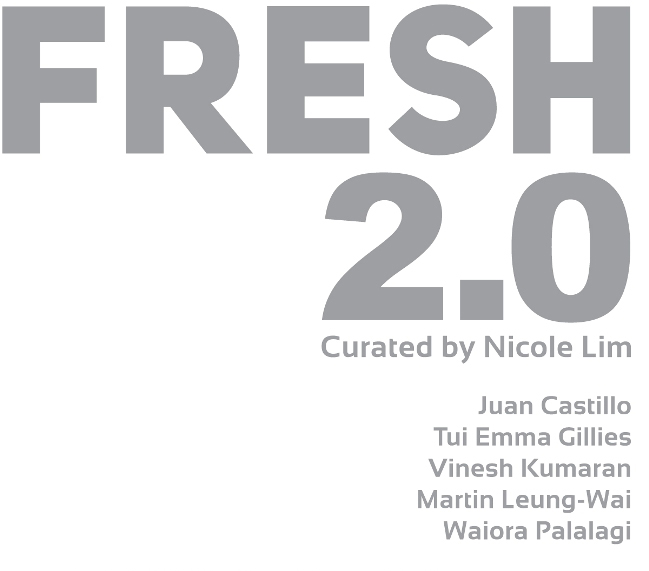
Fresh 2.0

Fresh Gallery Otara was established in May 2006 by Manukau City Council in partnership with the Otara community in South Auckland. As the manager and driver of Fresh, I produced 66 exhibitions from 2006-2012; I invested my blood, sweat and tears into the Gallery and loved my job but in June 2012, I left the role. The then Curatorial / Gallery Assistant, Nicole Lim took the reigns and has overseen the Gallery’s recent refurbishment and significant expansion.

This week, Fresh Gallery Otara re-opens as a new space under new leadership. I have unwavering support and loyalty to Nicole Lim and I can’t wait to see her first show in the new space.

Juan Castillo is a Chilean artist who produced a multifaceted work called Minimal-Baroque in 2006 as part of his residency at what was then Manukau School of Visual Arts. He collaborated with Otara artist, Leilani Kake to film a series of vox pops at Fresh Gallery Otara, asking members of the community and visitors to Fresh, “What is Art?”

The video is a historical and fascinating insight into community perceptions of the word ‘art’ – I’m so glad Nicole has chosen to re-show it.

Francis Falaniko, photographed by Vinesh KumaranVinesh Kumaran is a long-time collaborator and his input into Fresh Gallery Otara, SOUTH publication and the Pacific Arts Summits has been significant. His excellent series shot for the exhibition South Style (2009) is being re-shown and like Minimal-Baroque, exists as a historical record of South Auckland social history.

Fresh 2.0 is an exhibition that recognises the legacy of Fresh Gallery Otara, its significant relationships with Manukau Institute of Technology’s Faculty of Creative Arts (previously known as Manukau School of Visual Arts) and its enormous potential as a hub for creativity in the heart of grassroots South Auckland.

Great job, Nicole and go well, Fresh!

SOUTH Issue 2 (2013)
For the past six months I’ve worked with my long-time collaborator, Nigel Borell to produce a second issue of the free arts publication, SOUTH.

We established SOUTH in 2010 as co-editors and launched the first issue in January 2011 at Fresh Gallery Otara. Despite significant changes in budgets, energy and employment, Nigel persisted with the vision and Issue 2 was born. His hard work has attracted investment and financial support from Manukau Institute of Technology (Faculty of Creative Arts) and the Creative Communities Scheme, all of which has enabled me to return to the shared editorial role in a freelance capacity. We’re excited to be working with a new group of stakeholders and look forward to extending the investment opportunities for Issue 3!

Nigel and I have a close working relationship with Edgar Melitao, SOUTH’s design partner and artistic director. Choosing a front cover image is a highlight of the design and editorial process; it seems to bring everything together and galvanise the conviction of the publication.

I produced an experimental fashion editorial for SOUTH Issue 2 working with local designers Melissa Cole, Genevieve Pini and Tyrone Tautiepa. Shot on location in the South Auckland suburbs of Otara, Middlemore and Papatoetoe, the designers were challenged to research and develop, style and direct their own shoots with photographer, Vinesh Kumaran.


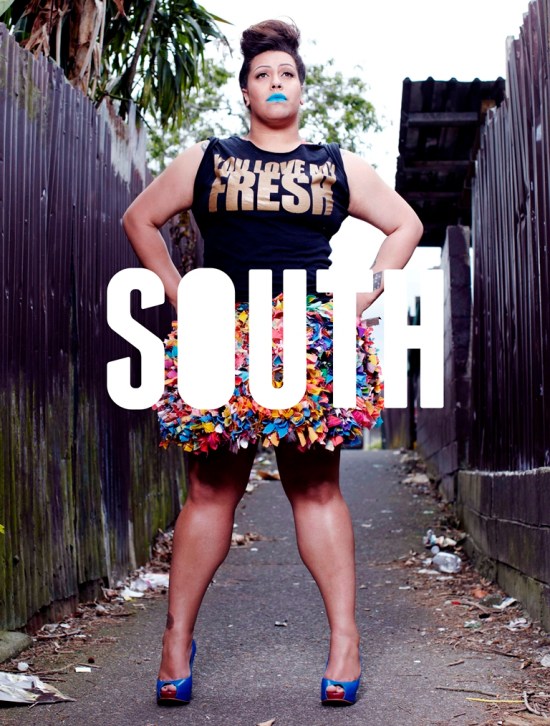
The SOUTH Issue 2 cover shot was styled and art directed by Otara-based Samoan artist and designer, Genevieve Pini. Pairing her own design, the Miss Lavalava skirt (featured in the 2012 Cult Couture fashion award show) with a limited edition chopped & screwed YOU LOVE MY FRESH t-shirt by Tanu Gago (a Mangere-based Samoan artist) she wanted her image to be fierce and empowered, and to represent an homage to her hood.

As a cover, this image represents the defiant and robust nature of the South Auckland arts sector: its strength, urbanity, Pacific Island cultural richness and unique vernacular. As a representation of the Pacific Island body, it is empowered, relatively unedited and unapologetically XXL. As the model and producer of this image, I love that it enabled an artist to engineer her own representation.

SOUTH is a free annual arts publication published by Toi o Manukau. It is available at art centres and libraries throughout South Auckland and at selected art spaces in the Auckland region.

Join SOUTH on Facebook to comment, share and engage with the SOUTH community.

I’m currently writing a profile on Otara-based Samoan visual artist, Genevieve Pini for the upcoming issue of SOUTH.

Genevieve went to McAuley High School in Ōtāhuhu before studying at Manukau School of Visual Arts (now MIT Faculty of Creative Arts) and NZ Fashion Tech. She has regularly featured in South Auckland’s annual fashion competition, Cult Couture and shown numerous times at Fresh Gallery Otara.

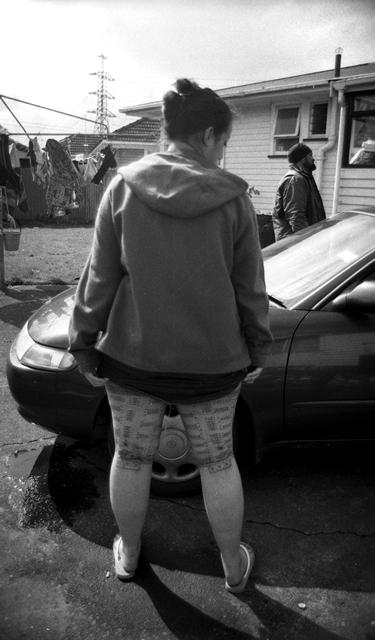
I’ve always loved this photograph Genevieve shot in 2004. She took it at the house where she got her malu (traditional Samoan female tattoo) in Otara.I love the light on the subject’s shoulder and all the South Auckland signifiers.

I’m interested in Genevieve’s attitudes towards exhibiting, making and being tattooed, and enjoying the process of writing about her.

SOUTH is an annual publication about Māori and Pacific arts and culture in South Auckland. The upcoming issue will be launched on Saturday 12 January 2013 at Papakura Art Gallery. More info coming soon!


I’m producing a fashion editorial for the upcoming issue of SOUTH, an arts publication I co-edit with Nigel Borell about Maori and Pacific arts and culture in South Auckland. Three South Auckland designers will be styling a series of concept images about their inspiration, space, style and creative conviction. I tagged along with Samoan designer Genevieve Pini to find an alleyway as a location for one of her ideas. This alleyway in between Dawson Road and Zelda Avenue in Otara was a winner.

In a sea of ‘Council brown’ (the colour so many urban spaces are painted in an effort to discourage tagging and graffiti), a banana tree towers over the rickety tin fence in a burst of tropical greens. I love it.

SOUTH Issue will be launched at the opening of Concealed Ancestors at Papakura Art Gallery, South Auckland on 12 January 2013!

1 Comment

My Pacific & My Auckland

Story by Ema Tavola

Fundamentally, I am opposed to the idea of Auckland being called a Pacific city. I don’t take the word Pacific lightly. It describes my heritage, community and socio-political context, and Auckland reflects little to nothing of who I am.

I am from Suva, Fiji – an actual Pacific city. Fiji’s capital is teeming with Nesian flavour. Void of resorts, Suva is a melting pot of the Pacific with its embassies, regional organisations, tertiary institutions and thriving commercial centres. Pacific people, Fiji people, are the newsmakers, the politicians, the event planners, the strategists, the teachers… the leaders. While plagued with political instability for much of my lifetime, Suva is where the Pacific is truly present.

I live in South Auckland and have studied and worked in Otara for the past decade. The community I call home here in New Zealand is predominantly Polynesian. In Otara, New Zealand’s demographics are turned upside down and the Pacific community defines, creates and is the mainstream. I feel close to the Pacific because I am surrounded by Pacificness – language, laughter, children, brown skin, food and movement. I still get a culture shock when I leave South Auckland and I feel a deep sense of relief when I return.

Because I am embedded in a sense of the Pacific proper and also in the Pacific relocated in Otara, Pacificness for me is where we/I am visible. In Auckland, the Pacific community makes up 14 per cent of the population, less than that of the Asian community and less than a third of that of Pākehā. We are a minority on the margins. As such, Pacific people and issues rarely feature in mainstream media and are rarely seen in advertising. Our representation in the leadership and governance of Auckland is grossly under par. For a Pacific city, Pacific people seem fairly invisible.

Auckland is a settler city now home to a multitude of ethnic groups. Central Auckland hosts the annual Pasifika festival attracting broad audiences to a two-day celebration of Pacific music, food and culture.

But Pasifika is no more important than the other major cultural events like the Lantern Festival celebrating Chinese New Year, and Diwali Festival of Lights. These large-scale culture expos paint a picture of Auckland’s diverse economic potential, giving minority communities the civic limelight for one to two days in the year.

But Auckland is home to the majority of New Zealand’s Pacific population. Now generationally entrenched, over 50 per cent of the population is New Zealand born. The Pacific diaspora has become increasingly integrated into the social fabric of New Zealand and as the community grows, identities evolve. For many Pacific people, our perceived identity is not related so much to where we are, but to where we have become visible when previously we were invisible. The number of Pacific Islanders playing elite schoolboy rugby has grown from almost none to domination of many of the teams.

This creates a problematic measure of Pacific identity. It is arguably a model of oppressed thinking from a community still over-represented in statistics around poor educational achievement, poverty and political dislocation. It feels like a strange colonial Stockholm syndrome that stops us expecting and demanding more of a country that has been built in part on the backs of Pacific labour.

If Auckland were truly a Pacific city I would expect a deeper consciousness about Pacific people and ideas, the wider region and our relationship with not only Polynesia, but Melanesia and Micronesia.

Whilst we have visibility in sports and in small windows of programming on mainstream television, we need to have visibility in decision-making at local and central government levels. We need more leadership in our community, in order to have presence and contribute fully to the Auckland dynamic. Potentially, strong and informed Pacific leaders could confront the large-scale political disenfranchisement we saw so clearly in our last national elections.

In a truly Pacific Auckland, engagement with Pacific communities would be meaningful, intergenerational and mutually beneficial. Mainstream institutions would not only foster relationships with Pacific communities, but actively deliver programming which appeals and educates wider audiences on Pacific lives and experiences.

I’d like to think that in an Auckland conscious of its Pacific community, we would stop building environments that enslave and harm our most disadvantaged sectors.

There are too many urban health hazards: there shouldn’t be liquor stores and takeaways on every corner and substandard imported food sold at every dairy in Mangere, Otara and Ōtāhuhu.

SkyCity and everyone else who introduces pokie machines to the community should be considered stakeholders in problem gambling, and held responsible for the damage they cause.

Tighter regulations around targeted and exploitative money lending would stabilise a community already faced with disproportionate financial challenges.

Sports commentators, news readers and leaders would be educated in how to pronounce Pacific names, and they would understand that mispronunciation is offensive and unnecessary.

Right now in New Zealand, emigration has never looked so appealing. Like many of my friends and networks, I look for jobs regularly in Australia.

If I left, the truth is I would miss South Auckland terribly. I would miss this little piece of the Pacific with its abundance of churches, swarms of brown children, multi-coloured everything. Here, Pacific people have made their mark – survived adversity and built strong, proud communities. Much of South Auckland exists in a parallel universe to the wider Auckland region; it was a self-sufficient little world before the Super City.

If an amalgamated Auckland means South Auckland’s Pacificness is now part of a bigger blander civic picture, then perhaps Auckland is a Pacific City. But there is no doubt in my mind that South Auckland is its beating heart.

This article was written for Metro magazine (August 2012)
4 Comments

South Auckland multimedia artist Siliga David Setoga is currently showing in Home AKL at Auckland Art Gallery (until 22 October). We share a love and respect for Otara – he has been selling t-shirts at the Otara Market under his label, Popohardwear for the past decade. Setoga held his first solo exhibition at Fresh Gallery Otara during my time as the manager and curator.  He made this shirt for me and I love it.